


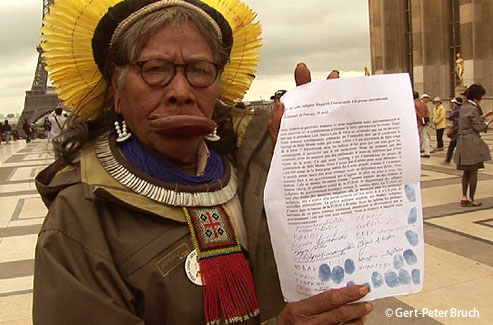
Now 502906 signatures.
BELO MONTE: the UN comes to threatened indigenous peoples’ rescue
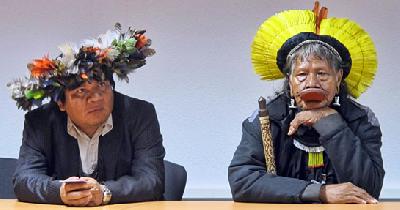
Chief Almir Narayamoga Surui and Kayapo Chief Raoni on September 30, 2011 at the UN, in Geneva.
At the heart of the human rights protection system of the United Nations, James Anaya is the former Special Rapporteur on the Human Rights and Fundamental Liberties of Indigenous Peoples, and he already pointed out Brasilia in his report on August 26, 2009, which has been presented to the General Assembly.
James Anaya notably wrote in his report that he ratified the International Labour Organization’s Convention No.169 which deals with the rights of indigenous and tribal peoples. He also supported the United Nations Declaration on the Rights of Indigenous Peoples to be adopted. The Brazilian government has to implement the rights of the indigenous people according to the international and relevant standards. Moreover, Brazilian offers important constitutional and legal protections to the indigenous peoples; the special Rapporteur notices that many impediments keep preventing the indigenous peoples of Brasilia from wholeheartedly enjoying their fundamental rights.
Following this report, in a letter dated April 6, 2010, the special Rapporteur, James Anaya, called the Brazilian government’s attention to two construction projects that would significantly affect the indigenous peoples in the country: the construction of the Belo Monte dam in the state of Para, and the flow of the Sao Francisco River.
He indicated the Belo Monte dam would reduce the water level of the river, diminishing the fishing resources on which the indigenous communities depend. Besides, since the river is the only way to export to the neighboring communities, natives peoples from the Xingu River basin expect to be even more geographically isolated, which will also prevent them from getting access to Social Services. The lowering of the river surface-water may have a considerable ecological impact as it represents an important ecological regulator in the region.
At the same time, in a non-binding agreement dated April 1, 2011, the Inter-American Commission on Human Rights requested the State of Brazil to immediately suspend the licensing process for the Belo Monte dam project and stop any construction work from moving forward until certain minimum conditions were met with the indigenous peoples. One can read: "The IACHR orders the Brazilian government to immediately suspend the licensing process of the Belo Monte dam". Furthermore, the Commission asks Brazil to adopt some "preventive measures" to help a dozen of indigenous peoples, and some of those peoples live isolated in the Xing River basin, at the heart of the Amazon Rainforest.
According to the IACHR, "life and integrity" of these peoples are "threatened by the impact of the construction" of this dam. "The Inter-American Commission asked the State of Brasilia to perform consultations in compliance with the international duties," like those required by the Brazilian Constitution, the international agreement as well as the American Convention on Human Rights, Convention 169 of the International Labour Organization and the declaration of the UN about the rights of the native communities. Finally, the IACHR requires those processes to be "instructive, bona fide, culturally appropriate and that they aim to come to an agreement". In response, "the president of Brazil, Mrs. Dilma Rousseff, decided to suspend relations between her government and the Inter-American Commission on Human Rights (IACHR) of the Organization of American States (OAS)"
On June 3, 2011, Marianne Duarte from Conectas Direitos Humanos declared, in the name of the Human Rights Council of the United Nations, her concern about the Belo Monte hydroelectric dam project in the Amazon Basin, considering the complaints drawn from the Inter-American Commission on Human Rights, dealing with the lack of public consultation, especially with the indigenous peoples and the impact studies. She also said the "the attitude of the Brazilian government weakened one the principal foundations of the international protection on human rights by ignoring the importance of the regional human rights system and duties".
Finally, the Xingu Vivo para Sempre movement directly filed a complaint against the IACHR on June 16, 2011, in order to formally condemn the Brazilian government which was charged with violations of its international law obligations. On October 27, 2012 in Washington, a hearing was organized by the Organization of American States, in order to deal with the controversial construction of the Belo Monte dam, but Brasilia did not take part in it. Mrs Andressa Caldas, the NGO’s lawyer and director, says that "the decision to not attend obviously demonstrates the cowardice of the government who (…), wants to avoid being blamed publically."
During his September 2011 trip to Europe, thanks to the mediation of the Swiss Society for Threatened Peoples, the members of Planète Amazone accompanied Chief Raoni, the leader of the Kayapo people, to Geneva in order for him to meet the senior officials from the Office of the United High Commissioner for Human Rights (OHCHR).
Chief Raoni was also able to decide on a common strategy, with the help of Planète Amazone and Chief Almir Narayamoga Surui who also met with representatives from the International Labour Organization (ILO) in order for the representatives from the OHCHR sector on "Indigenous peoples and minorities" and those from the ILO to undertake a common action in Brazil to support the implementation of recommendations made by James Anaya, Special Rapporteur of the Rights of Indigenous Peoples, and to request that a complaint be filed by the Board of Directos of the ILO in respect to Brazil’s non-compliance to Article 2 of Convention 169.
The complaint cannot be filed by only one person. Most of the time, they are filed by the country’s unions who are represented by a member from the Administration Council or in the ILO. When the Administration Council receives a complaint, they can designate a Commission of Inquiry composed of three independent members to proceed to an extensive examination of the complaint, to establish the facts, and to express recommendations implementing measures to solve the current problems.
Following this meeting, an ILO’s Commission of Inquiry was nominated to examine the Belo Monte case. In March 2012, the ILO asked Brasilia to "Take the necessary steps to carry out consultations with the Indigenous Peoples affected ... on the construction of the Belo Monte hydroelectric plant before the harmful effects of the plant may have become irreversible" (Articles 6 and 15 of the Convention) then "to communicate updated information on the result of those procedures in process before the IACHR and the federal tribunal of Pará" which both judged the construction of the dam to be illegal. The conclusion of this report from the Commission’s experts of the enforcement of the conventions and recommendations of the ILO is essential because the ILO Convention 169 is an international legal instrument which provides compulsory provisions to protect the indigenous peoples’ rights, with respect to their social and cultural identity, their customs and traditions, and their institutions. All of these international legal obligations should be considered together when evaluating a State’s responsibility to protect human rights.
Convention 169 states in Article 2 that the government must assume the responsibility of developing the detailed actions, with the participation of the indigenous peoples, to protect their rights and to guarantee the respect of their integrity. These actions include measures to guarantee the same rights and opportunities on an equal basis with other members of society.
When a country refuses to fulfill the recommendations of a Commission of Inquiry, the Governing Body can take action under article 33 of the ILO Constitution. This provision states that "[in] the event of any Member failing to carry out within the time specified the recommendations, if any, contained in the report of the Commission of Inquiry, or in the decision of the International Court of Justice, as the case may be, the Governing Body may recommend to the Conference such action as it may deem wise and expedient to secure compliance therewith."
As an answer to these recommendations from the ILO’s Commission of Inquiry, Brazil assured to take action in the future, by virtue of the principles of the Convention, but Brazil also announced it will not deal with the matters of procedure and decisions made concerning the Belo Monte’s and the Jiraù’s dams, both located in the Brazilian Amazon. Many opponents to Belo Monte’s project wait for the reaction of the ILO facing these declarations."
"The Xingu River can be turned into a river of blood" assured the Kayapos Xipaya, Juruna and Arara. If all the legal and peaceful methods are exhausted, the chiefs say there will be a war.
- by Valérie Cabanes (translated from French to English by Audrey Predessac & Anne-Marie Wells) -
By threatening the heart of the amazon forest, the BELO MONTE dam is standing in the way of our future.